

About
Korean Essay Test (KET)
CEFR Grade System
The CEFR was developed by the European Union and is the most widely used international language proficiency standard worldwide.
- A
- BeginnerA1, A2
- B
- IntermediateB1, B2
- C
- AdvancedC1, C2
KET's 10-Level Grade System
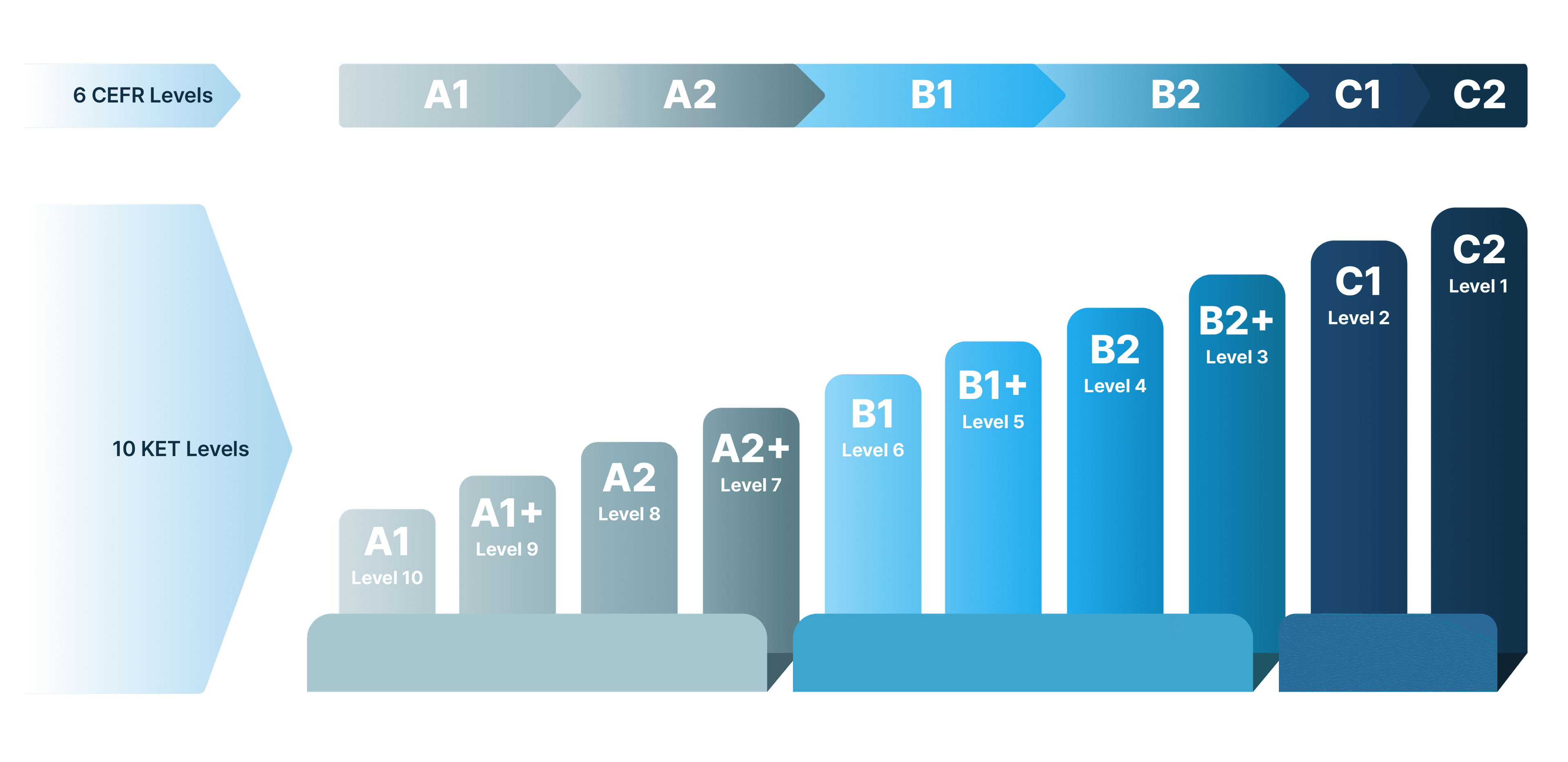
KET subdivides the 6 CEFR levels into 10 levels to measure Korean essay proficiency with greater precision.
KET can be used as proof of language ability when applying for jobs or selecting educational institutions. (KET levels are aligned with TOPIK sublevels)
Grade Details
* Scores below 50% will be marked as Fail.
Holders of this qualification can logically and structurally articulate their opinions on diverse topics in Korean, and perform Korean document writing and communication duties required in professional business and academic environments.
| Grade | Job Duties by Grade |
|---|---|
| Level 1 | Can perfectly write professional Korean argumentative essays, analytical reports, and plans in macro-level academic research and high-level business environments. |
| Level 2 | Can fluently write long narratives with logical structure, in-depth analytical reviews, and business documents on a wide range of social and academic topics. |
| Level 3 | Can write multi-paragraph essays on abstract or complex social issues, organically structuring specific evidence to support their arguments. |
| Level 4 | Can write paragraph-centered explanatory texts and proposals with clear causal relationships about general social phenomena or areas of interest, with natural cohesion. |
| Level 5 | Can write multi-sentence narratives and brief reports on personal interests or familiar social topics, including specific reasons, explanations, and examples. |
| Level 6 | Can write texts conveying their thoughts or basic information about everyday events or familiar environments using plain Korean expressions and sentence structures. |
| Level 7 | Can link simple short sentences about concrete, everyday subjects to write brief opinions or descriptive texts. |
| Level 8 | Can write at a level that records their surroundings, everyday needs, or simple facts using basic vocabulary and standardized sentence patterns. |
| Level 9 | Can write short, simple sentence-level expressions using words and phrases with very familiar and concrete information, combined with basic connectors. |
| Level 10 | Can write very fragmentary texts at the word or simple sentence level about the most basic self-introductions, everyday words, or very familiar objects. |
Proficiency Descriptions by Grade
KET-3Advanced (TOPIK Sublevels 5~6)
- Level 1C2
- Can synthesize specialized materials from multiple sources and write complex genre texts logically and strategically appropriate to context.
- Can adjust style to intention and effectively reflect politeness and socio-cultural elements.
- Level 2C1
- Can analyze and reason about specific topics in academic or professional contexts and produce structured writing suited to the discourse purpose.
- Can adapt style across genres and use expressions appropriate to formal contexts.
KET-2Intermediate (TOPIK Sublevels 3~4)
- Level 3B2+
- Can compare, analyze, and reason about general topics to produce structured and persuasive writing.
- Can support arguments with evidence and maintain logical flow.
- Level 4B2
- Can organize practical genre texts such as reports and personal statements for work or academic purposes.
- Can use formal style and cohesive devices reasonably well.
- Level 5B1+
- Can write opinions on familiar social or abstract topics in reasonable detail, using cohesive devices and discourse markers to form two or three paragraphs.
- Level 6B1
- Can write comparative and explanatory texts on everyday or familiar social topics.
- Can distinguish between formal and informal styles and use a variety of tenses.
KET-1Beginner (TOPIK Sublevels 1~2)
- Level 7A2+
- Can write short paragraph-level texts on everyday topics, using simple connectors and conjunctive adverbs.
- Can produce descriptive and explanatory writing.
- Level 8A2
- Can write short texts about personal experiences or familiar everyday topics.
- Can form simple compound sentences using basic tenses, vocabulary, and connective endings.
- Level 9A1+
- Can write two or three simple sentences on everyday personal topics and produce basic texts including functions such as suggesting or explaining.
- Level 10A1
- Can briefly express their daily routine or experiences using very basic vocabulary and grammar to write simple sentences.
- Can use connective endings in a limited way.